ArcRefine
To change what a protein does, it often matters where another protein binds to it. One way to block an interaction, for example, is to cover the surface where the usual partner attaches. When designing such a binder, can we improve its amino acid sequence while keeping the intended position and orientation?
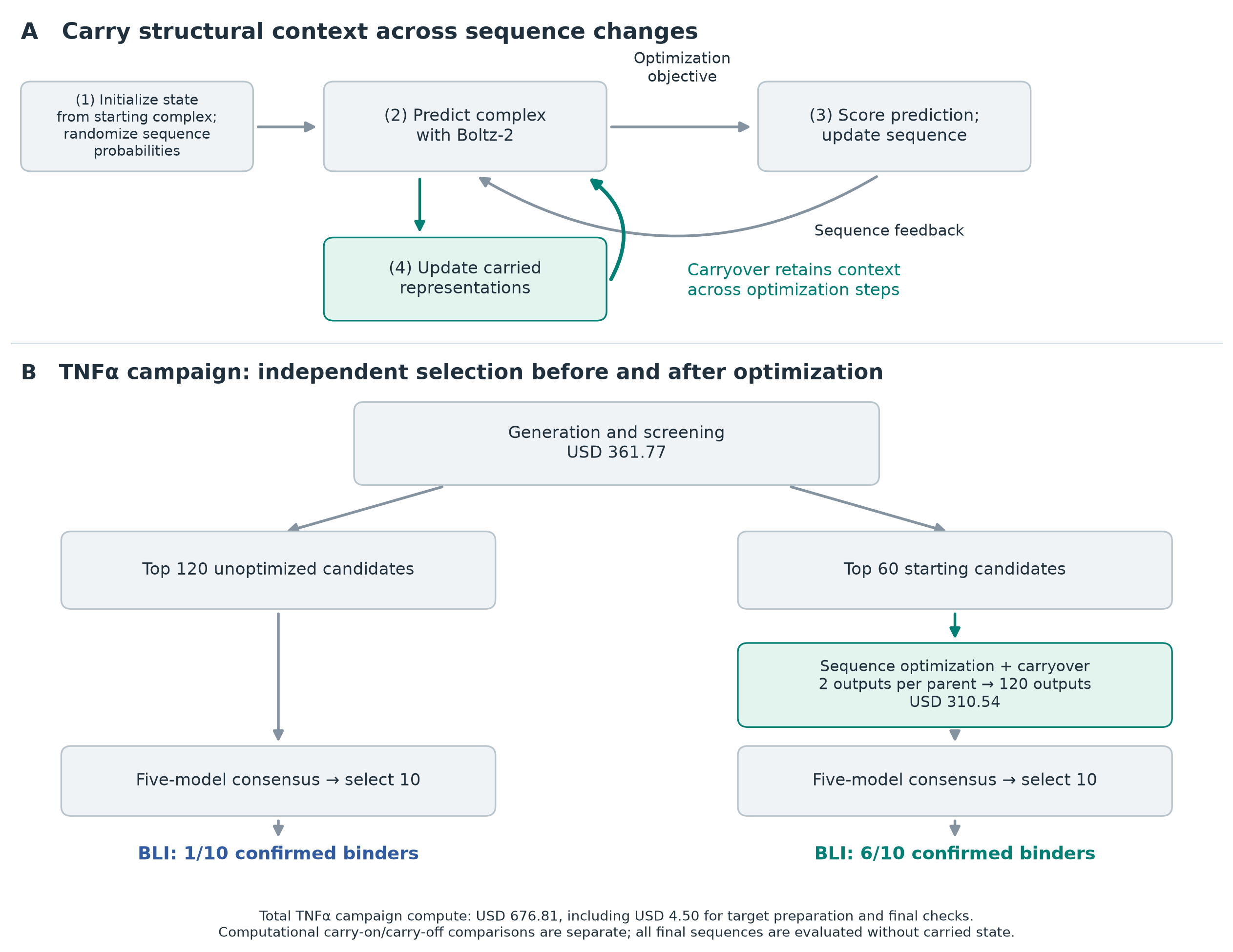
At FoldArc, we developed ArcRefine, a method for refining existing binder designs. It uses structural carryover to pass structural information from one sequence update to the next. In our computational tests, many designs kept their starting binding arrangements even after about two-thirds of their residues changed. In experiments against TNFα, 6 of 10 optimized designs bound their target.
Connecting two approaches to binder design
RFdiffusion and BoltzGen can generate binder shapes for a chosen site on a target. Finding designs that bind in experiments, however, often means generating and filtering a large pool of candidates. BoltzGen, for example, recommends generating 10,000–60,000 designs per target.
BindCraft takes another approach: it uses structure predictions to update amino acid sequences step by step, seeking structures that the predictor considers more credible. This workflow has reported high experimental success rates. Keeping a particular binding site remains difficult, though. A gap remains between generating a shape at a chosen site and improving its sequence while preserving that arrangement.
Our aim is to connect these steps: use structure predictions to improve a sequence while retaining the binding arrangement supplied by generation.
Carrying structural information through sequence changes
ArcRefine makes this connection through structural carryover. We first predict the original binder with its target using Boltz-2 and retain structural information held inside that prediction. After each sequence update, we pass the preceding prediction’s structural information into the next one. This gives each new prediction a starting context. It does not freeze the structure: both sequence and shape remain free to change.
What we tested
For PD-L1 and TNFα, many designs retained their starting binding arrangements after about two-thirds of their amino acids changed. We checked this with fresh structure predictions that received none of the carried information. Six other predictors, which were not used to optimize the sequences, also showed higher average confidence in the predicted binding interfaces.
In experiments, 6 of 10 optimized TNFα designs bound, compared with 1 of 10 unoptimized designs. For PD-L1, the corresponding results were 4 of 10 and 1 of 10. Candidates were selected independently for each group, so these experiments compare the outputs of the design workflows. They do not isolate the effect of structural carryover alone or establish that binding occurs at the predicted site.
We also explored redesigning proteins that bind DNA or small molecules in computational tests; binding of those redesigned sequences has not yet been measured.
Paper and code
The paper page gives the comparison conditions, evaluation methods and full results. It also links to the supplementary data, the PDF, the Zenodo record and the code.
Code is available for noncommercial use under PolyForm Noncommercial 1.0.0; contact ken@foldarc.com for commercial permission. Third-party components retain their original licenses.
At FoldArc, we use this method to design binders.
Cite this work
Osumi, K. ArcRefine improves de novo binder designs while preserving binding modes. FoldArc (2026).