Investigate individual interaction partners
When one protein interacts with several partners, a knockout can make their contributions difficult to distinguish. We design binders as tools to help test the role of a particular interaction.
CUSTOM PROTEIN DESIGN
Block a protein interaction to investigate what it does. FoldArc designs binders for selected sites on your target and delivers sequences and computational evaluations for experimental testing.
You can start the conversation before choosing a binding site.
Start with the interaction to inhibit
10 sequences and evaluationsStandard scope
Published methods and binding results ↗
EXPLORE PROTEIN INTERACTIONS
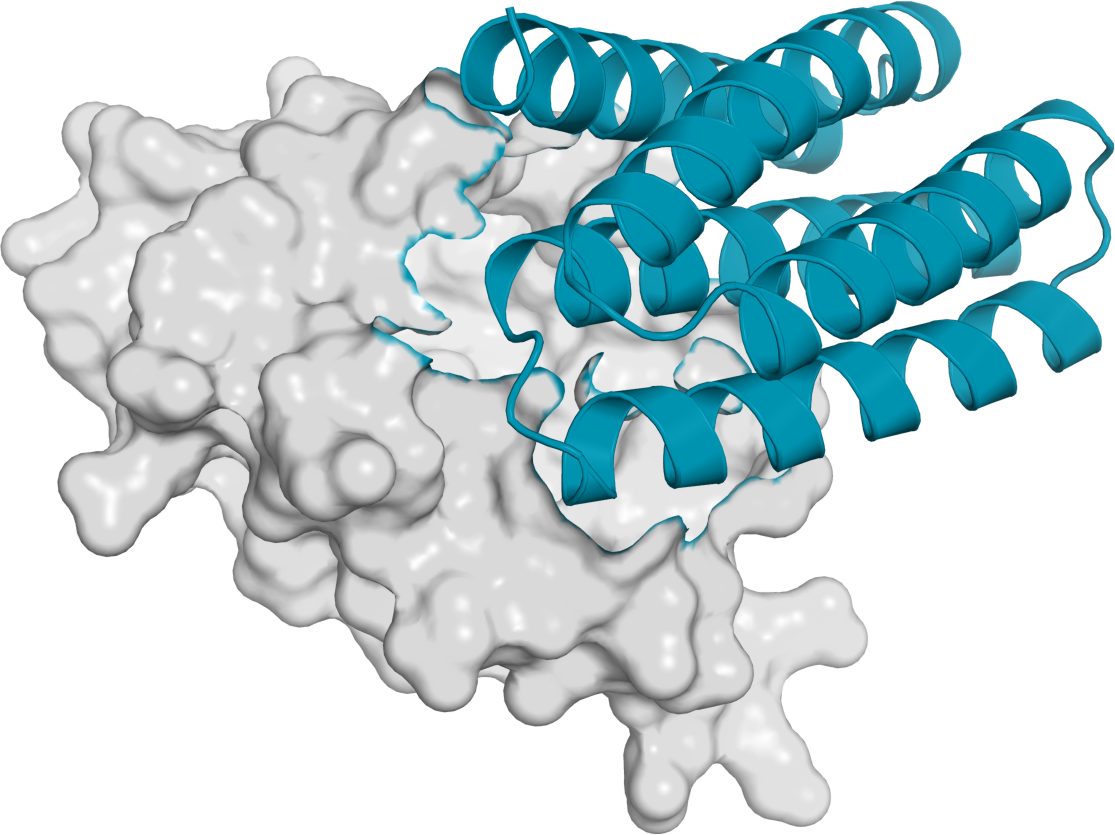
Binders are small proteins that attach to a target’s surface.
We design them to bind an interaction interface, with the aim of blocking a specific protein interaction.
When one protein interacts with several partners, a knockout can make their contributions difficult to distinguish. We design binders as tools to help test the role of a particular interaction.
For interactions that are difficult to study with existing inhibitors, we assess possible binding sites using the target structure and information about its partner, then select candidates for experimental testing.
START WITH YOUR RESEARCH QUESTION
We discuss your objective and experimental system to choose a binding site together. Our standard deliverables are designed sequences and computational evaluations. Binding and effects on the interaction or function are then tested in your experiments.
OUR DESIGN METHOD
We combine generation, sequence optimization, and evaluation with multiple structure prediction models to select candidates for experiments.
We consider your target structure and research objective, then use multiple generative models to produce approximately 10,000 candidate designs as a starting point.
Our ArcRefine method passes structural information between prediction steps to refine sequences while preserving the original binding pose.
We assess predicted binding modes and confidence using multiple structure prediction models, then deliver selected sequences with their computational evaluations.
EXPERIMENTAL EVIDENCE
Adaptyv Bio evaluated 40 submitted designs by biolayer interferometry (BLI): 10 from each unoptimized and optimized group for PD-L1 and TNFα.
Read the research overview ↗BINDING-POSITIVE / SUBMITTED DESIGNS
The groups were independently selected and compare the complete design workflows. These results demonstrate binding, not cellular inhibition or a success rate for new targets.
ArcRefine improves de novo binder designs while preserving binding modes
Ken Osumi · Preprint (not peer reviewed) · DOI: 10.5281/zenodo.23115832WHAT YOU RECEIVE
Selected for your target and application,
delivered as electronic data for your lab.
This is the standard scope. Sequence count and deliverables are agreed for each project.
We discuss tags, fusion domains, species, and other requirements during design.
Predicted binding poses and computational metrics help you choose candidates for experiments.
Gene synthesis, plasmid delivery, and outsourced protein production or binding measurements can be arranged under a separate scope and quotation.
HOW WE WORK
Review the initial design results and quotation before deciding whether to proceed with a full project.
FREE · ABOUT 1 WEEK
We discuss your target, research question, and experimental system, then assess binding sites and computational feasibility.
REVIEW BEFORE YOU DECIDE
We present the feasibility results, proposed deliverables, and cost. You decide whether to commission the full design.
ABOUT 2 WEEKS AFTER ORDER
We generate, optimize, and select candidates, then deliver sequences and evaluations. Further design work can be discussed in light of experimental results.
Timelines are estimates. Synthesis and outsourced assays require additional scheduling. Expression, binding, and function are tested in your experimental system after delivery.
USING YOUR DESIGNS
Typical uses after receiving the sequences.
Gene delivery and protein production or purification are carried out by your lab or your service provider.
Introduce a gene encoding the binder. Choose a promoter for the desired expression conditions and use tags to assess expression and localization.
Add the produced and purified binder to your experimental system and vary its concentration to assess binding or activity.
Typical designs are around 100 amino acids and 10–20 kDa. Gene synthesis, plasmid delivery, or production and assay arrangements are discussed separately if needed.
OTHER APPLICATIONS
Alongside interaction inhibition, we can discuss binder designs for these applications.
To investigate the presence or localization of a target. We design binding probes with your detection site, tags, and assay in mind.
To help stabilize a state of interest or provide a marker for identifying particle position and orientation. We assess binding sites in the context of your target structure and the state you want to observe.
Detection performance and stabilization effects require application-specific experimental evaluation.
QUESTIONS
Yes. Start with your target, the function you want to investigate, and any known interaction partners. We use available structures and structure predictions to assess possible sites and computational feasibility.
This is a custom design service. We design new binders for your target and research objective. You can review a free feasibility design and a quotation before deciding whether to commission the full project.
The standard deliverables are sequences and computational evaluations. Expression, binding, and the intended function are tested in your experimental system. Computational assessments do not guarantee experimental binding or activity. Outsourced protein production or binding measurements can be discussed as a separate scope.
Amino acid and DNA sequences, together with computational evaluations for each design, are delivered electronically. Gene synthesis and plasmid delivery are available by arrangement. Tags, fusion domains, and species requirements can be discussed during design.
We provide a quotation and a proposed scope with the feasibility results. Cost depends on the target, binding site, selectivity requirements, and delivery format. The initial feasibility design is free, with no obligation to proceed.
SERVICE GUIDE
Learn about applications, experimental results, and how a project works. Download the English PDF immediately after submitting the form.